Key Takeaways
- check_circle Payday loans are short-term, small-dollar loans (typically $100-$1,000) due on your next payday, usually within 2-4 weeks
- check_circle Fees range from $15-$30 per $100 borrowed, which translates to an APR of roughly 391%-780% on a two-week term
- check_circle Approval is fast and credit-score-friendly, but the high cost and rollover trap make it essential to have a repayment plan before you borrow
- check_circle Regulations vary dramatically by state — some ban payday loans entirely, while others impose few restrictions on fees or rollovers
list Table of Contents expand_more
A car breaks down on Monday. The rent is due Friday. Your checking account is short by $400. Sound familiar? According to the Federal Reserve, nearly 40% of American adults would struggle to cover an unexpected $400 expense without borrowing or selling something. That gap between an emergency and the next paycheck is exactly where payday loans live.
Roughly 12 million Americans use payday loans each year, collectively borrowing more than $9 billion. For some, it is a financial lifeline that covers an urgent bill. For others, it becomes a cycle of debt that is hard to escape. The difference almost always comes down to understanding how the product works before you sign.
This guide walks you through every aspect of payday lending — what the loan actually is, how much it costs in real dollars, what happens on repayment day, which states allow it, and what alternatives exist. Whether you are considering a payday loan for the first time or want to understand the pros and cons of payday loans, this article gives you the facts you need to make an informed decision.
Which payday option fits your situation?
Payday loans aren't one-size-fits-all. Jump straight to the guide that matches your situation:
What Is a Payday Loan?
A payday loan is a short-term, high-cost loan designed to bridge the gap between an immediate cash need and your next paycheck. The name says it all — you borrow money now and repay it on your next payday, typically within 14 to 30 days.
Here are the defining characteristics:
- arrow_right Loan amount — Typically ranges from $100 to $1,000, depending on state law and your income level. The national average payday loan is around $375.
- arrow_right Loan term — Usually 2 to 4 weeks, aligned with your pay schedule. Some states cap terms at 31 days; others allow slightly longer.
- arrow_right Repayment method — You either write a post-dated check or authorize an electronic withdrawal (ACH debit) from your bank account for the loan amount plus fees.
- arrow_right No collateral required — Payday loans are unsecured. You do not need to put up your car, home, or any other asset.
- arrow_right Minimal credit requirements — Most payday lenders do not check your FICO score, making these loans accessible to people with payday loans with bad credit histories or no credit at all.
Unlike installment loans, which you repay over months or years in scheduled payments, a payday loan demands the full balance — principal plus fees — in a single lump sum. That single-payment structure is what makes payday loans both fast and risky. If your next paycheck cannot absorb the full repayment without leaving you short again, you can end up borrowing again to cover the gap.
Pro Tip
Before you apply, calculate whether your next paycheck can cover the loan repayment and your regular expenses. If repaying the full amount will leave you short for rent, groceries, or bills, a payday loan may start a borrowing cycle rather than solve the problem.
How the Application Process Works
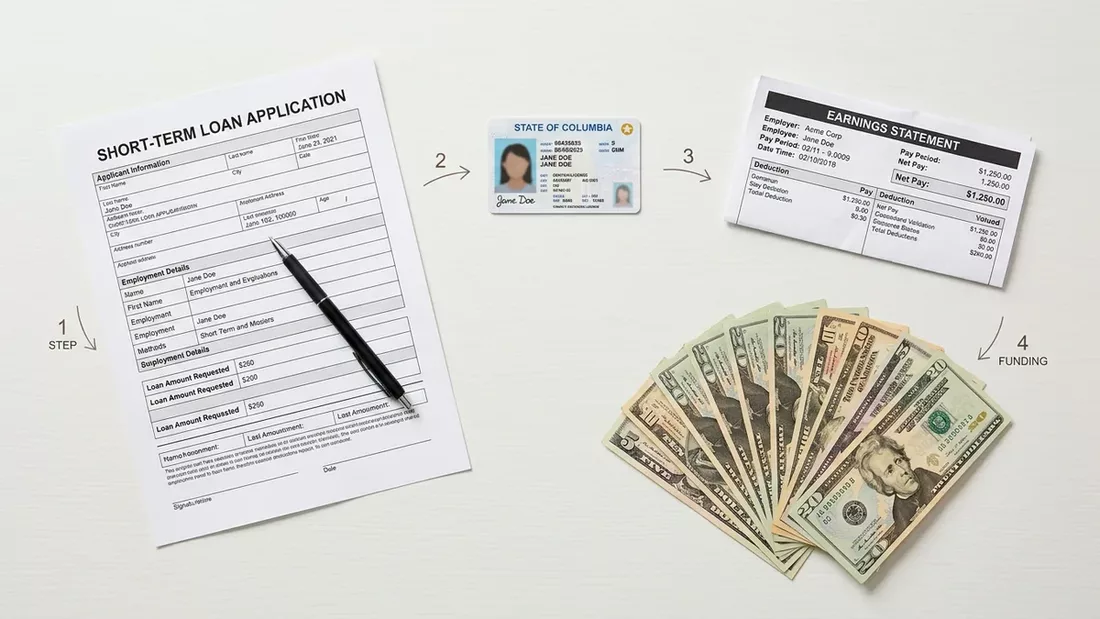
One of the primary appeals of payday loans is speed. The entire process — from application to cash in hand — can take as little as 15 minutes in a storefront location and under 24 hours online. Here is a step-by-step breakdown of what to expect:
-
1
Gather Your Documents
You will need a valid government-issued photo ID (driver's license, state ID, or passport), proof of income (recent pay stubs, bank statements showing direct deposits, or benefit award letters), an active checking account, and your Social Security number. Some lenders also require proof of address, such as a utility bill.
-
2
Submit Your Application
You can apply at a physical storefront or through an online payday loans from direct lenders website. Online applications typically ask for the same information — personal details, employment data, bank account and routing numbers — and take about 5 to 10 minutes to complete.
-
3
Receive a Decision
Most lenders provide a decision within minutes. Rather than pulling your traditional credit report, they may use alternative data sources — your banking history, income verification, and existing payday loan databases — to assess eligibility. Applicants seeking instant approval payday loans should know that "instant" refers to the speed of the decision, not the funding.
-
4
Review and Sign the Agreement
If approved, you will receive a loan agreement detailing the borrowed amount, fees, APR, due date, and what happens if you cannot repay. Read every line. Federal law (Truth in Lending Act) requires lenders to disclose the finance charge in dollars, the APR, and the total you will owe.
-
5
Receive Your Funds
In-store applicants may receive cash or a check immediately. Online borrowers typically see funds deposited into their bank account by the next business day via ACH transfer. Some lenders offer same-day funding through instant transfer networks for an additional fee of $5-$10.
The True Cost of Payday Loans
Understanding payday loan costs requires looking beyond the flat fee. A $15 finance charge on a $100 loan does not sound alarming — until you convert it to an annual rate or compare it to other forms of credit.
How Fees Are Calculated
Payday lenders charge a flat fee per $100 borrowed, usually between $15 and $30 depending on your state's regulations. So if you borrow $400 at $15 per $100, your fee is $60. On your due date, you repay $460 (the $400 principal plus the $60 fee).
That $15-per-$100 fee over a 14-day period works out to an annual percentage rate (APR) of approximately 391%. At $20 per $100, the APR climbs to roughly 521%. At $30 per $100, you are looking at about 780% APR. These numbers seem extreme — and they are — but remember that APR is a standardized comparison tool designed for annual borrowing. Payday loans are designed to last weeks, not years. The problem arises when borrowers roll loans over repeatedly, effectively making the annual rate a reality.
Cost Comparison: Payday Loans vs. Other Credit
To put payday loan costs in perspective, here is how they stack up against other common borrowing options for a $400 loan:
| Loan Type | Typical APR | Cost on $400 (2 weeks) | Total Repaid |
|---|---|---|---|
| Payday Loan | 391%-780% | $60-$120 | $460-$520 |
| Credit Card Cash Advance | 25%-30% | $3-$5 + fee | ~$415-$425 |
| Personal Loan | 6%-36% | $1-$5 | ~$401-$405 |
| Credit Union PAL | 28% (capped) | $4 + up to $20 fee | ~$424 |
| Paycheck Advance App | 0% (tip-based) | $0-$14 (optional tip) | $400-$414 |
The difference is stark. For the same $400 borrowed over two weeks, a payday loan costs 12 to 30 times more than a credit card cash advance and up to 60 times more than a personal loan. That gap is why understanding the full cost — and considering emergency cash options — is critical before committing.
Important
The average payday loan borrower ends up paying $520 in fees to repeatedly borrow $375, according to the Consumer Financial Protection Bureau (CFPB). Most of that cost comes from rollovers — not the original loan. If you cannot repay in full on the first due date, the costs escalate quickly.
Payday Loan Repayment: What to Expect
Repayment day is where payday loans either work as designed or start creating problems. Understanding exactly what happens — and what your options are if you cannot pay — is essential.
How Repayment Works
On your due date (usually your next payday), the lender collects the full amount owed — principal plus fees — through one of two methods:
- arrow_right Post-dated check — You wrote a check for the full repayment amount when you took out the loan. The lender deposits it on the due date.
- arrow_right ACH auto-debit — The lender automatically withdraws the amount from your checking account. This is the most common method for online payday loans.
There is no gradual paydown. Unlike installment vs payday loans where you make monthly payments, a payday loan demands everything at once. If you borrowed $400 plus a $60 fee, you need $460 available in your account on the due date.
The Rollover Trap
Here is where many borrowers run into trouble. If you cannot afford to repay the full amount, most lenders offer a rollover (also called a renewal). You pay another fee to extend the loan for an additional pay period. The principal stays the same — you are just paying a new fee for more time.
For example: You borrowed $400 with a $60 fee. On the due date, you cannot afford $460. You pay $60 to roll the loan over for another two weeks. Now you have paid $120 in fees and still owe $400. Roll it over again and you have paid $180 in fees without reducing the balance by a single dollar. According to the CFPB, 80% of payday loans are rolled over or followed by another loan within 14 days. The median borrower takes out 10 payday loans per year.
What If You Cannot Pay?
If you default entirely, several things can happen:
- arrow_right Failed withdrawal attempts — The lender may try to debit your account multiple times, potentially triggering overdraft fees from your bank ($30-$35 each).
- arrow_right Collections — The debt may be sold to a third-party collection agency, which will contact you by phone, mail, and email.
- arrow_right Credit damage — While most payday lenders do not report on-time payments to credit bureaus, they (or collection agencies) can report defaults, which hurts your credit score.
- arrow_right Legal action — In some states, lenders can pursue a lawsuit. However, payday lenders cannot threaten you with criminal charges for non-payment — that is illegal.
Your best move if you cannot pay: Contact the lender before the due date. Many states require lenders to offer an extended payment plan (EPP) at no additional charge, typically giving you 4 additional pay periods to repay without extra fees. Ask for this option — it is often available but not advertised.
State-by-State Regulations
Payday loan laws vary enormously across the United States. Some states have banned the practice entirely, while others allow it with minimal oversight. Where you live determines how much you can borrow, what fees are legal, and what protections you have. Here is a snapshot of regulations in key states:
| State | Max Loan Amount | Max Fee per $100 | Cooling-Off Period | Rollovers Allowed |
|---|---|---|---|---|
| California | $300 | $17.65 per $100 | None | No |
| Texas | No state cap | No state cap | None | Yes (unlimited) |
| Florida | $500 | $10 per $100 (+ $5 verification) | 24 hours | No |
| New York | Banned | N/A (25% APR cap) | N/A | N/A |
| Ohio | $1,000 | 28% APR + fees | None | No (min 91-day term) |
| Illinois | $1,000 or 25% of income | 36% APR cap (2024+) | 7 days | No |
Key takeaway: Before borrowing, look up your state's specific payday lending laws. States with strong consumer protections — cooling-off periods, rollover bans, and fee caps — significantly reduce the risk of a debt spiral. If you live in a state with no cap on fees or rollovers (like Texas), proceed with extra caution and explore the small-dollar loans landscape for potentially better options.
Need Cash Before Payday?
Compare your options in minutes. Check your rate with no impact to your credit score.
Check My RateOnline vs. In-Store Payday Loans
You have two main channels for getting a payday loan: walking into a brick-and-mortar location or applying through a website. Each has distinct advantages and risks. Understanding the differences helps you choose the safer, more convenient option for your situation.
In-Store Advantages
- add_circle Cash in hand immediately — no waiting for ACH transfer
- add_circle Face-to-face interaction lets you ask questions and negotiate
- add_circle Easier to verify the lender is licensed in your state
- add_circle No risk of online data breaches or phishing scams
Online Advantages
- add_circle Apply from anywhere, 24/7 — no need to visit a physical location
- add_circle Easier to compare multiple lenders and fees quickly
- add_circle More privacy — no one sees you walking into a payday loan storefront
- add_circle Funds deposited directly into your bank account
What to Watch for With Online Lenders
The online payday loan space includes legitimate direct lenders, but it also attracts predatory operators and outright scammers. Before submitting personal information online, verify that the lender is licensed in your state (check your state's financial regulator website), look for a physical address and working phone number, read the loan agreement in full, and never pay an upfront fee before receiving your loan — legitimate lenders deduct fees from the loan proceeds, not before.
Also be aware of lead generators — websites that look like lenders but actually sell your application to the highest bidder. You may end up receiving calls from multiple companies you never applied to. Look for clear language stating whether the site is a direct lender or a matching service.
Who Uses Payday Loans and Why
Payday loan borrowers are not a monolithic group. They span a wide range of incomes, occupations, and circumstances. According to Pew Charitable Trusts research, the typical payday loan borrower earns about $30,000 per year, is between 25 and 44 years old, and does not have access to traditional credit. But people with higher incomes use them too — anyone can face a sudden cash gap.
The most common reasons people take out payday loans include:
- arrow_right Car repairs — An unexpected breakdown that threatens your ability to get to work. The average car repair costs $500-$600, which aligns closely with typical payday loan amounts.
- arrow_right Medical bills — Emergency room visits, prescriptions, or dental work that insurance does not fully cover. Over 60% of personal bankruptcies in the U.S. involve medical debt.
- arrow_right Utility disconnection — Covering a past-due electric, gas, or water bill to avoid service interruption, especially during extreme weather.
- arrow_right Rent shortfall — Bridging a gap when income falls short of the monthly rent, preventing late fees or eviction proceedings.
- arrow_right Avoiding overdraft fees — Ironically, some borrowers use payday loans to prevent bank overdraft charges, which can cost $35 per transaction.
Regardless of the reason, the underlying driver is almost always the same: a mismatch between when a bill is due and when income arrives. That is a timing problem — and payday loans are, at their core, a timing solution. The question is whether the cost of that solution is justified compared to the alternatives.
Alternatives to Payday Loans
Before turning to a payday loan, explore these alternatives that often provide the same quick cash at a fraction of the cost. Some require planning ahead; others are available in emergencies. For a deeper dive, see our guide to types of loans.
-
1
Credit Union Payday Alternative Loans (PALs)
Federal credit unions offer PALs with rates capped at 28% APR and application fees capped at $20. You can borrow $200-$1,000 with 1-6 months to repay. You need to be a credit union member, but many are easy to join. This is the single best alternative for most borrowers.
-
2
Payment Plans With Your Creditor
Many utility companies, medical providers, and landlords offer hardship payment plans. A phone call explaining your situation often results in an extension or installment arrangement — at no additional cost. Always ask before borrowing.
-
3
Employer Paycheck Advances
Some employers offer earned-wage access programs that let you draw on wages you have already earned before payday. Apps like Earnin, DailyPay, and Payactiv facilitate this with minimal or no fees. Ask your HR department what options are available.
-
4
Personal Installment Loans
If you qualify, an installment loan lets you spread repayment over months at a much lower APR (typically 6-36%). Even borrowers with imperfect credit may qualify for rates far below payday loan levels.
-
5
Credit Card Cash Advance
While not cheap (25-30% APR plus a 3-5% upfront fee), a cash advance still costs a fraction of a payday loan. If you have available credit, this option gives you immediate cash at your bank's ATM.
-
6
Local Assistance Programs
Nonprofits, churches, and community organizations often provide emergency assistance for rent, utilities, and food. Dial 211 to find local resources. Many people are unaware these programs exist or assume they will not qualify.
-
7
Debt Consolidation
If you are caught in a cycle of payday loan debt, a debt consolidation loan can combine multiple high-interest debts into a single, lower-rate payment — potentially saving hundreds or thousands in interest.
Red Flags: How to Avoid Predatory Lenders
Not all payday lenders are created equal. While many operate within the law, predatory lenders exploit borrowers with hidden terms, deceptive practices, and illegal operations. Here is a checklist of warning signs to watch for:
Warning Signs
- do_not_disturb_on Asks for upfront fees before disbursing the loan
- do_not_disturb_on Refuses to disclose the APR, total fees, or repayment terms
- do_not_disturb_on Is not licensed in your state (check your state regulator)
- do_not_disturb_on Pressures you to borrow more than you need
- do_not_disturb_on Threatens criminal prosecution for non-payment
Signs of a Legitimate Lender
- add_circle Clearly discloses all fees, APR, and total repayment amount
- add_circle Is licensed and registered with your state's financial regulator
- add_circle Has a physical address, working phone number, and customer support
- add_circle Offers an extended payment plan if you cannot repay on time
- add_circle Gives you time to read the agreement — never rushes you to sign
If a lender exhibits any of the warning signs above, walk away. Report them to your state attorney general's office and the CFPB. There are enough legitimate options — including licensed payday lenders and other emergency cash options — that you never need to do business with a predatory operator.
"Our research shows that the biggest risk with payday loans isn't the first loan — it's the inability to repay in full and the subsequent cycle of re-borrowing. Borrowers who repay on time and do not re-borrow generally report a positive experience."
Frequently Asked Questions
Most payday lenders can approve your application within minutes. If you apply in-store, you can often walk out with cash or a check the same day. Online payday loans typically deposit funds into your bank account by the next business day, though some lenders offer same-day ACH or instant transfers for an additional fee.
The basic requirements include being at least 18 years old, having an active checking account, providing proof of steady income (such as pay stubs or bank statements), and presenting a valid government-issued ID. Most payday lenders do not perform a traditional credit check, so a low credit score typically will not disqualify you.
If you cannot repay on time, options vary by state. Some states allow rollovers, where you pay a fee to extend the loan for another pay period — though this significantly increases total costs. Other states require extended payment plans at no extra charge. If you default entirely, the lender may attempt to withdraw from your bank account, send your debt to collections, and report the default, which can damage your credit score.
No. Payday loan regulations vary significantly by state. Some states like New York, New Jersey, and Arizona have effectively banned traditional payday lending through strict interest rate caps. Other states like Texas and Utah have few restrictions. Many states fall somewhere in between, allowing payday loans but imposing caps on fees, loan amounts, and the number of rollovers permitted.
Payday loans typically charge $15 to $30 per $100 borrowed. For a standard two-week loan of $400 at $15 per $100, you would owe $460 on your next payday. When expressed as an annual percentage rate (APR), that $15-per-$100 fee translates to roughly 391% APR — far higher than credit cards (15-30% APR) or personal loans (6-36% APR). The true cost rises steeply if you roll the loan over.
The Bottom Line
Payday loans are a fast, accessible source of emergency cash — but they are also one of the most expensive ways to borrow money. If used correctly (borrowed once, repaid in full on the due date, and never rolled over), a payday loan can solve an urgent timing problem without long-term consequences.
The danger lies in the rollover cycle. Before you borrow, know the exact cost, confirm your state's regulations, have a clear repayment plan, and honestly assess whether the full repayment amount on your next payday will leave you with enough to cover your regular expenses. If it will not, explore alternatives first — credit union PALs, employer advances, payment plans, or checking your rate on a lower-cost installment loan. The best borrowing decision is an informed one.
Blue Sky Loans Editorial Team
Financial Content Specialists
Our editorial team is committed to providing accurate, unbiased financial content to help you make informed borrowing decisions. Each article is reviewed for accuracy and updated regularly to reflect the latest market conditions and lending regulations.